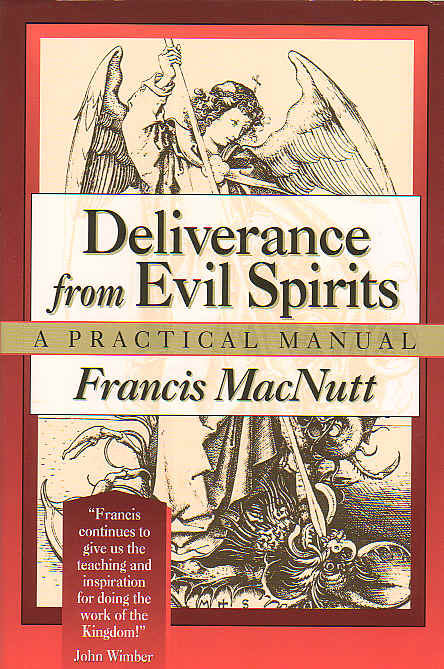
Deliverance from Evil Spirits  by Francis MacNutt, Do evil spirits oppress people today, including Christians? This practical manual is written by one of the foremost practitioners of Christian healing and deliverance. Highly recommended. Full of brilliant facts. If you want to know the ins and outs of casting away foul spirits -- and how they haunt us to begin with -- this book will provide those insights and examples. CLICK HERE  


__________________________________________________

From Christ to the World Blogspot.com:

Thursday, January 27, 2011

Vision of Hell - Venerable Bede

 
"A certain man," says Ven. Bede, "fell sick and died in the beginning of the night. Next morning, early, he suddenly came to life again, and sat up. He told the people what he had seen. 

 
'I was led,' he said, 'into a dark place. When I came into it, the darkness grew so thick that I could see nothing but the form of him who led me. I saw a great many balls of black fire rising up out of a deep pit and falling back again. I saw that there were souls shut up in these balls of fire. 

 
The smell which came out of the pit was unbearable. He who led me into this place went away. So I stood there in great fright, not knowing what to do. All at once I heard behind me voices crying and lamenting most fearfully. 

 
I heard other voices mocking and laughing. These voices came nearer and nearer to me, and grew louder and louder. Then I saw that those who were laughing and rejoicing were devils. These devils were dragging along with them souls of men which were howling and lamenting. Amongst them I saw a man and a woman. The devils dragged these souls down into the pit, I could not hear their voices so well. 

 
After a while, some of these dark spirits came up again from the flaming pit. They ran forward and came round me. I was terribly frightened by their flaming eyes, and the stinking fire which came out of their mouths and nostrils. They seemed as if they would lay hold of me with burning tongs, which they held in their hands. I looked around me for help. Just then I saw something like a star shining in the darkness. 

 
The light came from him who had brought me into this place. When he came near, the devils went away. 

 
Then he said: 'That fiery, stinking pit which you saw is the mouth of hell, and whosoever goes into it shall never come out again. Go back to your body and live among men again. Examine your actions well, and speak and behave so that you may be with the blessed in heaven.' When he had said this, on a sudden, I found myself alive again amongst men."
 

 - taken from The Sight of Hell, by Father John Furniss


Further Reading 
St John Bosco's - road to Hell

 
Terrifying vision of Hell - given to Sr Lucy - Our Lady of Fatima

 
St Teresa of Avila - the room created by the Devil for her

Monday, August 9, 2010

Saint John Vianney vs The Devil

 
The Cure d'Ars and the Devil

 
That Hell exists and that there are fallen angels condemned to hell, is a dogma of the Catholic faith. The devil is a personal, living being, not a figment of the imagination. True, his activity in the world remains for the most part, hidden; none the less, by divine permission, at times the evil one comes out into the open. 

 
For the space of 35 years - from  1824 to 1858 - the Cure d'Ars was subjected, even outwardly to the molestations of the evil one. What if, by preventing him from taking both food and sleep, Satan had succeeded in inspiring him with a distaste for prayer, penance and the exertions of the apostolic life, and in obliging him to give up the cure of souls!

 
But the enemy of our salvation was disappointed and defeated.


The Saint Attacked By The Powers Of Darkness

It was to be expected that so signal a triumph of religion, as well as the personal holiness of him who was instrumental in bringing it about, would rouse the fury of hell. The Scriptures tell us that Satan at times disguises himself as an angel of light. In our days he is even more cunning: he persuades people, all too successfully, that he does not exist at all. One of the most amazing features of the life of the Cure of Ars is that during a period of about thirty-five years he was frequently molested, in a physical and tangible way, by the evil one.

It should be borne in mind that all men are subject to temptation—for to tempt to sin is the devil's occupation, so to speak—and temptation is permitted by God for our good. is an of the devil, when he seeks to terrify by horrible apparitions or noises. goes further: it is either , when the devil acts on the external senses of the body; or , when he influences the imagination or the memory. occurs when the devil seizes on and uses the whole organism. But even then mind and will remain out of his reach. Most of the Cure of Ars' experiences belong to the first category, viz., .

 
The powers of darkness opened the attack in the winter of 1824. In the stillness of a frosty night terrific blows were struck against the presbytery door and wild shouting could be heard coming, so it seemed, from the little yard in front of the house. For a moment the Cure suspected the presence of burglars so that he asked the village wheelwright, one Andre Verchere, to spend the following night at the presbytery. It proved an exciting night for that worthy. Shortly after midnight there suddenly came a fearful rattling and battering of the front door whilst within the house a noise was heard as if several heavy carts were being driven through the rooms. Andre seized his gun, looked out of the window but saw nothing except the pale light of the moon: "For a whole quarter of an hour the house shook—and so did my legs," the would-be defender subsequently confessed. The following evening he received another invitation to spend the night at the presbytery but Andre had had enough.

These and similar disturbances were of almost nightly occurrence.
 They happened even when the Saint was away from home—in the early years when he was still able to lend a hand to his clerical neighbours. Thus on a certain night during a mission at St Trivier, the presbytery shook and a dreadful noise seemed to proceed from M. Vianney's bedroom. Everybody was alarmed, and rushing to the Saint's room the priests found him in his bed which invisible hands had dragged into the middle of the room. M. Vianney soon perceived that these displays of satanic humour were fiercest when some great conversion was about to take place, or, as he playfully put it, when he was about to "land a big fish." One morning the devil set fire to his bed. The Saint had just left his Confessional to vest for Mass when the cry, "Fire! fire!" was raised. He merely handed the key of his room to those who were to put out the flames: "The villainous !" (it was his nickname for the devil) "unable to catch the bird, he sets fire to the cage!" was the only comment he made. To this day the pilgrim may see, hard by the head of the bed, a picture with its glass splintered by the heat of the flames. It must be remembered that at no time was a fire lit in the hearth and there were no matches in the presbytery.

These molestations were both terrifying and ludicrous. The holy man ended by getting inured to them, so much so that he often poked fun at their author who showed himself in a very poor light indeed. With a smile the Saint once remarked: "Oh! the and myself—we are almost chums." As a sample of Satan's sense of humour the following is characteristic of one whom somebody called "God's ape." The devil would go on for hours producing a noise similar to that made by striking a glass tumbler with the blade of a steel knife; or he would sing, "with a very cracked voice," the Saint said, or whistle for hours on end; or he would produce a noise as of a horse champing and prancing in the room, so that the wonder was that the worm-eaten floor did not give way; or he would bleat like a sheep, or miaow like a cat, or shout under the Cure's window: "Vianney! Vianney! potato-eater." The purpose of these horrible or grotesque performances was to prevent the servant of God from getting that minimum of rest which his poor body required and thus to render him physically unfit to go on with his astonishing work in the confessional by which he snatched so many souls from the clutches of the fiend. But from 1845 these external attacks ceased almost entirely.

 
The Saint's constancy amid such trialswas rewarded by the extraordinary power God gave him to cast out devils from the possessed. Nevertheless, horrible as may be the condition of one whose body is possessed by the devil, it is as nothing by comparison with the wretched plight of a soul which, by mortal sin, sells itself, as it were, to Satan. The holy priest may be said to have spent the best part of his priestly career in a direct contest with sin through his unparalleled work in the confessional. The Cure's confessional was the real miracle of Ars, one that was not merely a passing wonder, or the sensation of a few weeks. Great as were his penances, assuredly the greatest of them all was the endless hours spent by him within the narrow confinement of a rugged, comfortless, unventilated confessional. This miracle went on for forty years. The astonishing thing about M. Vianney is that he himself personally became the object of a pilgrimage, people flocking to Ars in hundreds of thousands just to get a glimpse of him, to hear him, to exchange but a few words with him, above all, to go to confession to him.

 
It is said that the Devil told St. John Vianney, “If there were three such priests as you, my kingdom would be ruined. The Saint, for his part, developed a remarkable sense of humor about the supernatural assaults, saying, “Oh! the grappin” – his nickname for the Devil – “and myself? We are almost chums.”


It’s not likely that we’ll ever have to struggle with Satan the way St. John Vianney did, but we should be familiar with who he is and what he does – and why he must be resisted. That begins with acknowledging that he exists and that he wants to destroy us. It means knowing that although he is powerful, Satan is limited and he is already defeated (CCC 2852, 2864)


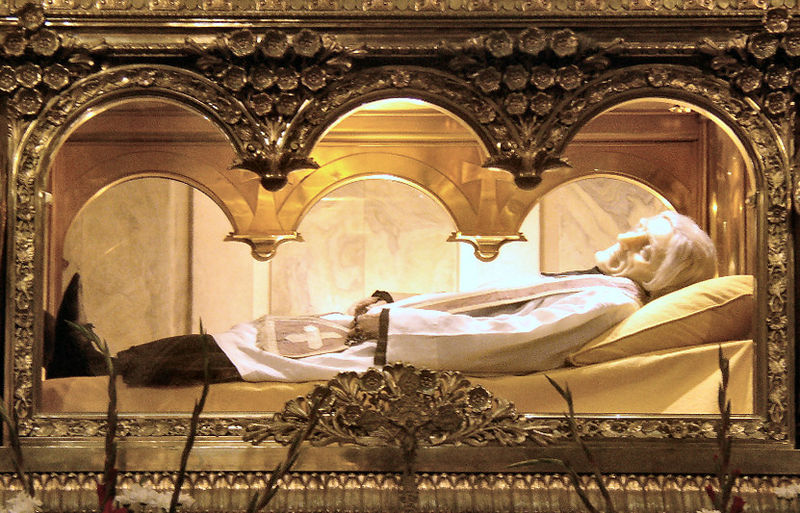
St. John Vianney - Incorrupt Relic (1786-1859) 

 
St John Vianney, Patron of Priests, pray for us and for all priests!


Source: http://www.ewtn.com/library/mary/cure.htm

Thursday, May 27, 2010

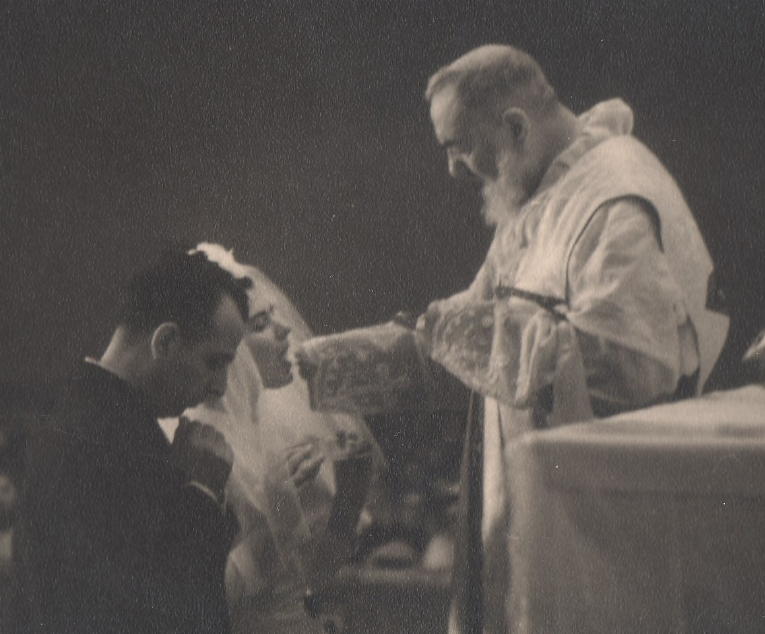
Saint Padre Pio vs The Devil

 
St Paul warns us in (Ephesians Ch 6: 12)  "For our struggle is not against flesh and blood, but against the rulers, against the powers, against the world forces of this darkness, against the spiritual forces of wickedness in the heavenly places."

 
One of the first contacts that Padre Pio had with the prince of evil occurred in 1906.  One night, Padre had returned to the convent of Saint Elia of Pianisi.  He couldn't fall asleep that night because of the enormous summer heat. He heard the footsteps of someone coming from a nearby room. Padre Pio thought, "Apparently, Friar Anastasio couldn’t sleep either."  He wanted to call out to him so that they could visit and speak for awhile. He went to the window and tried calling to his companion, but he was unable to speak. On the ledge of a nearby window, he saw a monstrous dog. Padre Pio, with terror in his voice, said, “I saw the big dog enter through the window and there was smoke coming from his mouth.  I fell on the bed and I heard a voice from the dog that said, "him it is, it is him". While I was still on the bed, the animal jumped to the ledge of the window, then to the roof and disappeared."

 
Evil Attacks

 
The Devil attacked Padre Pio with numerous types of temptations. Padre Augustine also confirmed that the Devil appeared to him under many different forms.  "The Devil appeared as young girls that danced naked, as a crucifix, as a young friend of the monks, as the Spiritual Father or as the Provincial Father; as Pope Pius X, a Guardian Angel, as St. Francis and as Our Lady.”  The Devil has also appeared in his horrible forms with an army of infernal spirits. There were other times when Padre Pio was approached by the Devil but without any apparition. He was troubled with deafening noises and covered with spittle, etc. Padre Pio succeeded in freeing himself from these attacks of the Devil by invoking the name of Jesus.

 
 The struggle between Padre Pio and Satan became more difficult when Padre Pio freed the souls possessed by the Devil.  Father Tarcisio of Cervinara said, "More than once, before leaving the body of a possessed, the Devil has shouted, "Padre Pio, you give us more trouble than St. Michael"; also, "Father Pio don't steal the bodies from us and we won't bother you."


In one of the letters to Padre Agostino, dated January 18, 1912, he stated, “The Devil does not want to lose this battle. He takes on many forms. For several days now, he has appeared with his brothers who are armed with batons and pieces of iron.  One of the difficulties is that they appear in many disguises. There were several times when they threw me out of my bed and dragged me out of my bedroom.  I am patient, however, and I know Jesus,Our Lady, my Guardian Angel, St. Joseph and St. Francis are always with me.”  


(PADRE PIO DA PIETRELCINA: Epistolario I° (1910-1922) a cura di Melchiorre da Pobladura e Alessandro da Ripabottoni - Edizioni "Padre Pio da Pietrelcina" Convento S.Maria delle Grazie San Giovanni Rotondo - FG)

 
Satan's Deception - 'Father of all lies'


Satan went beyond all the limits of deception when he went to Father Pio pretending to be a penitent. This is the Father Pio’s testimony:  “One day, while I was hearing confessions, a man came to the confessional where I was. He was tall, handsome, dressed with some refinement and he was kind and polite. He started to confess his sins, which were of every kind: against God, against man and against the morals. All the sins were obnoxious! I was disoriented, in fact for all the sins that he told me, but I responded to him with God’s Word, the example of the Church, and the morals of the Saints.   But the enigmatic penitent answered me word for word, justifying his sins, always with extreme ability and politeness.  He excused all the sinful actions, making them sound quite normal and natural, even comprehensible on the human level.. He continued this way with the sins that were gruesome against God, Our Lady, the Saints, always using disrespectful round-about argumentation. He kept this up even with with the foulest of sins that could be conjured in the mind of a most sinful man.  The answers that he gave me with such skilled subtlety and malice surprised me. I wondered: who is he? What world does he come from? And I tried to look at him in order to read something on his face. At the same time I concentrated on every word he spoke, trying to discover any clue to his identity.. But suddenly; through a vivid, radiant and internal light I clearly recognized who he was. With a sound and imperial tone I told him: “Say long live Jesus, long live Mary!” As soon as I pronounced these sweet and powerful names, Satan instantly disappeared in a trickle of fire, leaving behind him an unbearable stench.”  (Don Pierino is a priest and one of the father Pio’s spiritual sons who were present at the same time.)


Fr. Perino tells  this story:


 “One day, Padre Pio was in the confessional, hidden by two curtains. The curtains of the confessional were not closed all the way and I succeeded in seeing padre Pio. The men, following the bookings, were prepared on a side, all in single row. From the place where I was, I read the Breviary and, sometimes I  looked up to see the Padre. From the little church, through the door, a man came. He was handsome, with small and black eyes, grizzled hair, with a dark jacket and ruled trousers. I didn’t want him to distract me and  so I kept on reciting the breviary, but an internal voice told me: “Stop and look!“ I stopped and looked at padre Pio. That man, while taking footstep back and forth and without waiting his turn, stopped just in front of theconfessional, after the previous penitent went away. He immediately entered among the curtains, standing, up in front of padre Pio. Then I didn’t see the dark haired man after that moment. Following some minutes I saw that man sank on the floor with his legs widened. On the chair in the confessional, where Padre Pio had been sitting, I didn’t see padre Pio anymore; but, Jesus. He was blond, young and handsome and he gazed upon the man that had fell to the floor. Then again I saw padre Pio coming up from there. He returned to take a seat to in his place and his appearance melted with Jesus’ appearance. Then I saw only Padre Pio. I immediately heard his voice: “Hurry  up, everyone.”   Nobody noticed this happening!  Everybody started with their turn again. 


From the Catechism of the Catholic Church 

1034 Jesus often speaks of "Gehenna" of "the unquenchable fire" reserved for those who to the end of their lives refuse to believe and be converted, where both soul and body can be lost.

Thursday, April 8, 2010

Sister Josefa Menendez's Description of Hell


The following material is quoted verbatim from the book"Way of Divine Love" of Sister Josefa Menendez (1890--1923). 

Sister Josefa was a Spanish nun of the Society of the Sacred Heart and lived only four years as a religious, at the convent of Les Feuillants in Poitiers, France, where she died at the age of 33. 

"The Way of Divine Love" consists largely of her notebooks, that she wrote down under obedience from our Lord, with the revelations of his Sacred Heart, plus portions of her biography. This material was composed after Rev. Schouppe wrote his book on Hell.


This young Spanish sister, who had a short religious life of great suffering, experienced revelations throughout much of her life, compiled in The Way Of Divine Love. More than once, she was taken to Hell to witness and feel the suffering first-hand. Sister Josefa was reluctant to write on the subject of Hell, and did so only to conform to Our Lord's wishes. Sister Josefa repeatedly dwelt on what she described as the greatest torment of Hell, namely, the soul's inability to love. One of these damned souls cried out: "This is my torture...that I want to love and cannot; there is nothing left me but hatred and despair. If one of us could so much as make a single act of love...But we cannot, we live on hatred and malevolence..." (March 23, 1922).

 
She records, too, the accusations made against themselves by these unhappy souls: "Some yell because of the martyrdom of their hands. Perhaps they were thieves, for they say: 'Where is our loot now?' ...Cursed hands... Others curse their tongues, their eyes...whatever was the occasion of sin... 'Now, O body, you are paying the price of the delights you granted yourself!...and you did it of your own free will...'" (April 2, 1922).

 
"I saw several souls fall into Hell, and among them was a child of fifteen, cursing her parents for not having taught her to fear God nor that there was a Hell. Her life had been a short one, she said, but full of sin, for she had given in to all that her body and passions demanded in the way of satisfaction..." (March 22, 1923).

 
"My soul fell into abysmal depths, the bottom of which cannot be seen, for it is immense. . . ; Then I was pushed into one of those fiery cavities and pressed, as it were, between burning planks, and sharp nails and red-hot irons seemed to be piercing my flesh. I felt as if they were endeavoring to pull out my tongue, but could not. This torture reduced me to such agony that my very eyes seemed to be starting out of their sockets. I think this was because of the fire which burns, burns. . . not a finger nail escapes terrifying torments, and all the time one cannot move even a finger to gain some relief, not change posture, for the body seems flattened out and [yet] doubled in two. Sounds of confusion and blasphemy cease not for an instant. 

 
A sickening stench asphyxiates and corrupts everything, it is like the burning of putrefied flesh, mingled with tar and sulfur. . . a mixture to which nothing on earth can be compared. . . although these tortures were terrific, they would be bearable if the soul were at peace. But it suffers indescribably. . . All I have written," she concluded, "is but a shadow of what the soul suffers, for no words can express such dire torment." (September 4, 1922).

 
"Others curse their tongues, their eyes... whatever was the occasion of their sin... 'Now, O body, you are paying the price of the delights you granted yourself!.. and you did it of your own free will... '" (April 2, 1922). (That is, illegitimate delights).

 
"It seemed to me that the majority accused themselves of sins of impurity, of stealing, of unjust trading; and that most of the damned are in Hell for these sins." (April 6, 1922).

 
"I saw many worldly people fall into Hell, and no words can render their horrible and terrifying cries: 'Damned forever... I deceived myself; I am lost... I am here forever... There is no remedy possible... a curse on me...'

 
"Some accused people, others circumstances, and all execrated the occasions of their damnation." (September 1922).

 
"Today, I saw a vast number of people fall into the fiery pit . . . they seemed to be worldlings and a demon cried vociferously: 'The world is ripe for me . . . I know that the best way to get hold of souls is to rouse their desire for enjoyment . . . Put me first . . . me before the rest . . . no humility for me! but let me enjoy myself . . . This sort of thing assures victory to me . . . and they tumble headlong into hell.' " (October 4, 1923)

 
"I heard a demon, from whom a soul had escaped, forced to confess his powerlessness. 'Confound it all... how do so many manage to escape me? They were mine' (and he rattled off their sins)... 'I work hard enough, yet they slip through my fingers... Someone must be suffering and repairing for them.'" (January 15, 1923). ("Repairing," that is, "making reparation" for them).

 
"Tonight I was transported to a place where all was obscure. . . Around me were seven or eight people; I could see them only by the reflections of the fire. They were seated and were talking together. One said: 'We'll have to be very careful not to be found out, for we might easily be discovered.'

 
"The devil answered: 'Insinuate yourselves by inducing carelessness in them. . . but keep in the background, so that you are not found out. . . by degrees they will become callous, and you will be able to incline them to evil. Tempt these others to ambition, to self-interest, to acquiring wealth without working, whether it be lawful or not. Excite some to sensuality and love of pleasure. Let vice blind them. . . As to the remainder. . .  get in through the heart . . . you know the inclinations of their hearts. . . make them love. . . love passionately. . . work thoroughly. . .  take no rest . . . have no pity. Let them cram themselves with food! It will make it all the easier for us. . .  Let them get on with their banqueting. Love of pleasure is the door through which you will reach them . . .' " (February 3, 1923).

 
"Tonight," wrote Josefa, "I did not go down into Hell, but was transported to a place where all was obscure, but in the center was a red smoldering fire. They had laid me flat and so bound me that I could not make the slightest movement. Around me were seven or eight people; their black bodies were unclothed, and I could see them only by the reflections of the fire. They were seated and were talking together.

 
"One said: 'We'll have to be very careful not to be found out, for we might easily be discovered.'

 
"The devil answered: 'Insinuate yourselves by inducing carelessness in them... but keep in the background, so that you are not found out... by degrees they will become callous, and you will be able to incline them to evil. Tempt these others to ambition, to self-interest, to acquiring wealth without working, whether it be lawful or not. Excite some to sensuality and love of pleasure. Let vice blind them...' (Here they used obscene words).

 
"'As to the remainder... get in through the heart... you know the inclinations of their hearts... make them love... love passionately... work thoroughly.. take no rest... have no pity; the world must go to damnation.. and these souls must not be allowed to escape me.'

 
"From time to time Satan's satellites answered: 'We are your slaves... we shall labor unceasingly, and in spite of the many who war against us, we shall work night and day. We know your power!'

 
"They all spoke together, and he whom I took to be Satan used words full of horror. In the distance I could hear a clamor as of feasting, the clinking of glasses... and he cried: 'Let them cram themselves with food! It will make it all the easier for us... Let them get on with their banqueting. Love of pleasure is the door through which you will reach them...'

 
"He added such horrible things that they can neither be written nor said. Then, as if engulfed in a whirl of smoke, they vanished." (February 3, 1923).

 
"The evil one was bewailing the escape of a soul: 'Fill her soul with fear, drive her to despair. All will be lost if she puts her trust in the mercy of that...' (here they used blasphemous words about Our Lord). 'I am lost; but no, drive her to despair; do not leave her for an instant, above all, make her despair.'

 
"Then Hell re-echoed with frenzied cries, and when finally the devil cast me out of the abyss, he went on threatening me. Among other things he said: 'Is it possible that such weaklings have more power than I, who am mighty... I must conceal my presence, work in the dark; any corner will do from which to tempt them... close to an ear.. in the leaves of a book... under a bed... some pay no attention to me, but I shall talk and talk... and by dint of suggestion, something will remain.. Yes, I must hide in unsuspected places.'" (February 7, 8, 1923).

 
Again, she wrote: "Souls were cursing the vocation they had received, but not followed... the vocation they had lost, because they were unwilling to live a hidden and mortified life..." (March 18, 1922.

 
"On one occasion when I was in Hell, I saw a great many priests, religious and nuns, cursing their vows, their order, their Superiors and everything that could have given them the light and the grace they had lost...

 
"I saw, too, some prelates. One accused himself of having used the goods belonging to the Church illicitly..." (September 28, 1922).

 
"Priests were calling down maledictions on their tongues which had consecrated, on their fingers that had held Our Lord's Sacred Body, on the absolution they had given while they were losing their own souls, and on the occasion through which they had fallen into Hell." (April 6, 1922).

 
"One priest said: 'I ate poison, for I used money that was not my own... the money given me for Masses which I did I not offer.'
"Another said he belonged to a secret society which had betrayed the Church and religion, and he had been bribed to connive at terrible profanations and sacrileges.

 
"Yet another said that he was damned for assisting at profane plays, after which he ought not to have said Mass... and that he had spent about seven years thus."

 
Josefa noted that the greater number of religious plunged into hell-fire were there for abominable sins against chastity... and for sins against the vow of poverty... for the unauthorized use of the goods of the community... for passions against charity (jealousy, antipathies, hatred, etc.), for tepidity and relaxation; also for comforts they had allowed themselves and which had led to graver sins... for bad confessions through human respect and want of sincerity and courage, etc.

 
Here, finally, is the full text of Josefa's notes on "the hell of consecrated souls." (Biography: Ch. VII--September 4, 1922).

 
"The meditation of the day was on the Particular Judgment of religious souls. I could not free my mind of the thought of it, in spite of the oppression which I felt. Suddenly, I felt myself bound and overwhelmed by a crushing weight, so that in an instant I saw more clearly than ever before how stupendous is the sanctity of God and His detestation of sin.

 
"I saw in a flash my whole life since my first confession to this day. All was vividly present to me: my sins, the graces I had received, the day I entered religion, my clothing as a novice, my first vows, my spiritual readings, and times of prayer, the advice given me, and all the helps of religious life. Impossible to describe the confusion and shame a soul feels at that moment, when it realizes: 'All is lost, and I am damned forever.'"

 
As in her former descents into Hell, Josefa never accused herself of any specific sin that might have led to such a calamity. Our Lord meant her only to feel what the consequences would have been, if she had merited such a punishment. She wrote:

 
"Instantly I found myself in Hell, but not dragged there as before. The soul precipitates itself there, as if to hide from God in order to be free to hate and curse Him.

 
"My soul fell into abysmal depths, the bottom of which cannot be seen, for it is immense... at once, I heard other souls jeering and rejoicing at seeing me share their torments. It was martyrdom enough to hear the terrible imprecations on all sides, but what can be compared to the thirst to curse that seizes on a soul, and the more one curses, the more one wants to. Never had I felt the like before. Formerly my soul had been oppressed with grief at hearing these horrible blasphemies, though unable to produce even one act of love. But today it was otherwise.

 
"I saw Hell as always before, the long dark corridors, the cavities, the flames... I heard the same execrations and imprecations, for--and of this I have already written before--although no corporeal forms are visible, the torments are felt as if they were present, and souls recognize each other. Some called out, 'Hullo, you here? And are you like us? We were free to take those vows or not... but no!...' and they cursed their vows.

 
"Then I was pushed into one of those fiery cavities and pressed, as it were, between burning planks, and sharp nails and red-hot irons seemed to be piercing my flesh."

 
Here Josefa repeated the multiple tortures from which no single member of the body is excluded:

 
"I felt as if they were endeavoring to pull out my tongue, but could not. This torture reduced me to such agony that my very eyes seemed to be starting out of their sockets. I think this was because of the fire which burns, burns... not a finger-nail escapes terrifying torments, and all the time one cannot move even a finger to gain some relief, nor change posture, for the body seems flattened out and yet doubled in two.

 
"All this I felt as before, and although those tortures were terrific, they would be bearable if the soul were at peace. But it suffers indescribably. Until now, when I went down into Hell, I thought that I had been damned for abandoning religious life. But this time it was different. I bore a special mark, a sign that I was a religious, a soul who had known and loved God, and there were others who bore the same sign. I cannot say how I recognized it, perhaps because of the specially insulting manner in which the evil spirits and other damned souls treated them. There were many priests there, too. This particular suffering I am unable to explain. It was quite different from what I had experienced at other times, for if the souls of those who lived in the world suffer terribly, infinitely worse are the torments of religious. Unceasingly the three words, Poverty, Chastity and Obedience, are imprinted on the soul with poignant remorse.

 
"Poverty: You were free and you promised! Why, then, did you seek that comfort? Why hold on to that object which did not belong to you? Why did you give that pleasure to your body? Why allow yourself to dispose of the property of the Community? Did you not know that you no longer had the right to possess anything whatsoever, that you had freely renounced the use of those things?... Why did you murmur when anything was wanting to you, or when you fancied yourself less well treated than others? Why?

 
"Chastity: You yourself vowed it freely and with full knowledge of its implications... you bound yourself.. you willed it... and how have you observed it? That being so, why did you not remain where it would have been lawful for you to grant yourself pleasures and enjoyment?

 
"And the tortured soul responds: 'Yes, I vowed it; I was free... I could have not taken the vow, but I took it and I was free...' What words can express the martyrdom of such remorse," wrote Josefa, "and all the time the jibes and insults of other damned souls continue.

 
"Obedience: Did you not fully engage yourself to obey your Rule and your Superiors? Why, then, did you pass judgment on the orders that were given you? Why did you disobey the Rule? Why did you dispense yourself from common life? Remember how sweet was the Rule... and you would not keep it... and now," vociferate satanic voices, "you will have to obey us not for a day or a year, or a century, but forever and ever; for all eternity... It is your own doing... you were free.

 
"The soul constantly recalls how she had chosen her God for her Spouse, and that once she loved Him above all things... that for Him she had renounced the most legitimate pleasures and all she held dearest on earth, that in the beginning of her religious life she had felt all the purity, sweetness and strength of this divine love, and that for an inordinate passion... now she must eternally hate the God who had chosen her to love Him.
"This forced hatred is a thirst that consumes her... no past joys can afford her the slightest relief.

 
"One of her greatest torments is shame," added Josefa. "It seems to her that all the damned surrounding her continually taunt her by saying: 'That we should be lost who never had the helps that you enjoyed is not surprising... but you... what did you lack? You who lived in the palace of the King... who feasted at the board of the elect.'

 
"All I have written," she concluded, "is but a shadow of what the soul suffers, for no words can express such dire torments." (September 4, 1922).
Sunday, February 21, 2010

Blessed Anne Catherine Emmerich - vision of HELL

 
A Detached Account of the Descent into Hell

 
WHEN Jesus, after uttering a loud cry, expired, I saw his heavenly soul under the form of a bright meteor pierce the earth at the foot of the Cross, accompanied by the angel Gabriel and many other angels. His Divine nature continued united to his soul as well as to his body, which still remained hanging upon the Cross, but I cannot explain how this was, although I saw it plainly in my own mind. The place into which the soul of Jesus entered was divided into three parts, which appeared to me like three worlds; and I felt that they were round, and that each division was separated from the other by a hemisphere.
 
    I beheld a bright and beautiful space opposite to Limbo; it was enamelled with flowers, delicious breezes wafted through it; and many souls were placed there before being admitted into Heaven after their deliverance from Purgatory. Limbo, the place where the souls were waiting for the Redemption, was divided into different compartments, and encompassed by a thick foggy atmosphere. Our Lord appeared radiant with light and surrounded by angels, who conducted him triumphantly between two of these compartments; the one on the left containing the patriarchs who lived before the time of Abraham, and that on the right those who lived between the days of Abraham and St. John Baptist. These souls did not at first recognise Jesus, but were filled nevertheless with sensations of joy and hope. There was not a spot in those narrow confines which did not, as it were, dilate with feelings of happiness. The passage of Jesus might be compared to the wafting of a breath of air, to a sudden flash of light, or to a shower of vivifying dew, but it was swift as a whirlwind. After passing through the two compartments, he reached a dark spot in which Adam and Eve were standing; he spoke to them, they prostrated and adored him in a perfect ecstasy of joy, and they immediately joined the band of angels, and accompanied our Lord to the compartment on the left, which contained the patriarchs who lived before Abraham. This compartment was a species of Purgatory, and a few evil spirits were wandering about among the souls and endeavouring to fill them with anxiety and alarm. The entrance through a species of door was closed, but the angels rapped, and I thought I heard them say, ‘Open these doors.’ When Jesus entered in triumph the demons dispersed, crying out at the same time, ‘What is there between thee and us? What art thou come to do here? Wilt thou crucify us likewise?’ The angels hunted them away, having first chained them. The poor souls confined in this place had only a slight presentiment and vague idea of the presence of Jesus; but the moment he told them that it was he himself, they burst out into acclamations of joy, and welcomed him with hymns of rapture and delight. The soul of our Lord then wended its way to the right, towards that part which really constituted Limbo; and there he met the soul of the good thief which angels were carrying to Abraham’s bosom, as also that of the bad thief being dragged by demons into Hell. Our Lord addressed a few words to both, and then entered Abraham’s bosom, accompanied by numerous angels and holy souls, and also by those demons who had been chained and expelled from the compartment.

    This locality appeared to me more elevated than the surrounding parts; and I can only describe my sensations on entering it, by comparing them to those of a person coming suddenly into the interior of a church, after having been for some time in the burial vaults. The demons, who were strongly chained, were extremely loath to enter, and resisted to the utmost of their power, but the angels compelled them to go forward. All the just who had lived before the time of Christ were assembled there; the patriarch; Moses, the judges, and the kings on the left-hand side; and on the right side, the prophets, and the ancestors of our Lord, as also his near relations, such as Joachim, Anna, Joseph, Zacharias, Elizabeth, and John. There were no demons in this place, and the only discomfort that had been felt by those placed there was a longing desire for the accomplishment of the promise; and when our Lord entered they saluted him with joyful hymns of gratitude and thanksgiving for its fulfilment, they prostrated and adored him, and the evil spirits who had been dragged into Abraham’s bosom when our Lord entered were compelled to confess with shame that they were vanquished. Many of these holy souls were ordered by our Lord to return to the earth, re-enter their own bodies, and thus render a solemn and impressive testimony to the truth. It was at this moment that so many dead persons left their tombs in Jerusalem; I regarded them less in the light of dead persons risen again than as corpses put in motion by a divine power, and which, after having fulfilled the mission intrusted to them, were laid aside in the same manner as the insignia of office are taken off by a clerk when he has executed the orders of his superiors.

    I next saw our Lord, with his triumphant procession, enter into a species of Purgatory which was filled with those good pagans who, having had a faint glimmering of the truth, had longed for its fulfilment: this Purgatory was very deep, and contained a few demons, as also some of the idols of the pagans. I saw the demons compelled to confess the deception they had practised with regard to these idols, and the souls of the poor pagans cast themselves at the feet of Jesus, and adored him with inexpressible joy: here, likewise, the demons were bound with chains and dragged away. I saw our Saviour perform many other actions; but I suffered so intensely at the same time, that I cannot recount them as I should have wished.


    Finally, I beheld him approach to the centre of the great abyss, that is to say, to Hell itself; and the expression of his countenance was most severe.

    The exterior of Hell was appalling and frightful; it was an immense, heavy-looking building, and the granite of which it was formed, although black, was of metallic brightness; and the dark and ponderous doors were secured with such terrible bolts that no one could behold them without trembling. Deep groans and cries of despair might be plainly distinguished even while the doors were tightly closed; but, 0, who can describe the dreadful yells and shrieks which burst upon the ear when the bolts were unfastened and the doors flung open; and, 0, who can depict the melancholy appearance of the inhabitants of this wretched place!
 

    The form under which the Heavenly Jerusalem is generally represented in my visions is that of a beautiful and well-regulated city, and the different degrees of glory to which the elect are raised are demonstrated by the magnificence of their palaces, or the wonderful fruit and flowers with which the gardens are embellished. Hell is shown to me under the same form, but all within it is, on the contrary, close, confused, and crowded; every object tends to fill the mind with sensations of pain and grief; the marks of the wrath and vengeance of God are visible everywhere; despair, like a vulture, gnaws every heart, and discord and misery reign around. In the Heavenly Jerusalem all is peace and eternal harmony, the beginning, fulfilment, and end of everything being pure and perfect happiness; the city is filled with splendid buildings, decorated in such a manner as to charm every eye and enrapture every sense; the inhabitants of this delightful abode are overflowing with rapture and exultation, the gardens gay with lovely flowers, and the trees covered with delicious fruits which give eternal life. In the city of Hell nothing is to be seen but dismal dungeons, dark caverns, frightful deserts, fetid swamps filled with every imaginable species of poisonous and disgusting reptile. In Heaven you behold the happiness and peaceful union of the saints; in Hell, perpetual scenes of wretched discord, and every species of sin and corruption, either under the most horrible forms imaginable, or represented by different kinds of dreadful torments. All in this dreary abode tends to fill the mind with horror; not a word of comfort is heard or a consoling idea admitted; the one tremendous thought, that the justice of an all-powerful God inflicts on the damned nothing but what they have fully deserved is the absorbing tremendous conviction which weighs down each heart. Vice appears in its own, grim disgusting colours, being stripped of the mask under which it is hidden in this world, and the infernal viper is seen devouring those who have cherished or fostered it here below. In a word, Hell is the temple of anguish and despair, while the kingdom of God is the temple of peace and happiness. This is easy to understand when seen; but it is almost impossible to describe clearly.


    The tremendous explosion of oaths, curses, cries of despair, and frightful exclamations which, like a clap of thunder, burst forth when the gates of Hell were thrown open by the angels, would be difficult even to imagine; our Lord spoke first to the soul of Judas, and the angels then compelled all the demons to acknowledge and adore Jesus. They would have infinitely preferred the most frightful torments to such a humiliation; but all were obliged to submit. Many were chained down in a circle which was placed round other circles. In the centre of Hell I saw a dark and horrible-looking abyss, and into this Lucifer was cast, after being first strongly secured with chains; thick clouds of sulphurous black smoke arose from its fearful depths, and enveloped his frightful form in the dismal folds, thus effectually concealing him from every beholder. God himself had decreed this; and I was likewise told, if I remember rightly that he will be unchained for a time fifty or sixty years before the year of Christ 2000. The dates of many other events were pointed out to me which I do not now remember; but a certain number of demonsare to be let loose much earlier than Lucifer, in order to tempt men, and to serve as instruments of the divine vengeance. I should think that some must be loosened even in the present day, and others will be set free in a short time.

    It would be utterly impossible for me to describe all the things which were shown to me; their number was so great that I could not reduce them sufficiently to order to define and render them intelligible. Besides which my sufferings are very great, and when I speak on the subject of my visions I behold them in my mind's eye portrayed in such vivid colours, that the sight is almost sufficient to cause a weak mortal like myself to expire.
 

    I next saw innumerable bands of redeemed souls liberated from Purgatory and from Limbo, who followed our Lord to a delightful spot situated above the celestial Jerusalem, in which place I, a very short time ago, saw the soul of a person who was very dear to me. The soul of the good thief was likewise taken there, and the promise of our Lord, ‘This day thou shalt be with me in Paradise,’ was fulfilled.


    It is not in my power to explain the exact time that each of these events occurred, nor can I relate one-half of the things which I saw and heard; for some were incomprehensible even to myself, and others would be misunderstood if I attempted to relate them. I have seen our Lord in many different places. Even in the sea he appeared to me to sanctify and deliver everything in the creation. Evil spirits fled at his approach, and cast themselves into the dark abyss. I likewise beheld his soul in different parts of the earth, first inside the tomb of Adam, under Golgotha; and when he was there the souls of Adam and Eve came up to him, and he spoke to them for some time. He then visited the tombs of the prophets who were buried at an immense depth below the surface; but he passed through the soil in the twinkling of an eye. Their souls immediately re-entered their bodies, and he spoke to them and explained the most wonderful mysteries. Next I saw him, accompanied by a chosen band of prophets, among whom I particularly remarked David, visit those parts of the earth which had been sanctified by his miracles and by his sufferings. He pointed out to them, with the greatest love and goodness, the different symbols in the old law expressive of the future; and he showed them how he himself had fulfilled every prophecy. The sight of the soul of our Lord, surrounded by these happy souls, and radiant with light, was inexpressibly grand as he glided triumphantly through the air, sometimes passing, with the velocity of lightning, over rivers, then penetrating through the hardest rocks to the very centre of the earth, or moving noiselessly over its surface.

    I can remember nothing beyond the facts which I have just related concerning the descent of Jesus into Limbo, where he went in order to present to the souls there detained the grace of the Redemption which he had merited for them by his death and by his sufferings; and I saw all these things in a very short space of time; in fact, time passed so quickly that it seemed to me but a moment. Our Lord, however, displayed before me, at the same time, another picture, in which I beheld the immense mercies which he bestows in the present day on the poor souls in Purgatory; for on every anniversary of this great day, when his Church is celebrating the glorious mystery of his death, he casts a look of compassion on the souls in Purgatory, and frees some of those who sinned against him before his crucifixion. I this day saw Jesus deliver many souls; some I was acquainted with, and others were strangers to me, but I cannot name any of them.

    Our Lord, by descending into Hell, planted (if I may thus express myself), in the spiritual garden of the Church, a mysterious tree, the fruits of which—namely, his merits—are destined for the constant relief of the poor souls in Purgatory. The Church militant must cultivate the tree, and gather its fruits, in order to present them to that suffering portion of the Church which can do nothing for itself. Thus it is with all the merits of Christ; we must labour with him if we wish to obtain our share of them; we must gain our bread by the sweat of our brow. Everything which our Lord has done for us in time must produce fruit for eternity; but we must gather these fruits in time, without which we cannot possess them in eternity. The Church is the most prudent and thoughtful of mothers; the ecclesiastical year is an immense and magnificent garden, in which all those fruits for eternity are gathered  together, that we may make use of them in  time. Each year contains sufficient to supply the wants of all; but woe be to that careless or dishonest gardener who allows any of the fruit committed to his care to perish; if he fails to turn to a proper account those graces which would restore health to the sick, strength to the weak, or furnish food to the hungry! When the Day of Judgment arrives, the Master of the garden will demand a strict account, not only of every tree, but also of all the fruit produced in the garden.
 
Blessed  Anne Catherine Emmerich (1774-1824)
Mystic, Stigmatist, Visionary, and Prophet  


[For full site... linked stories may go to secular sites out of our control]

[Spirit Daily bookstore and gift shop]

Donations: we need and appreciate it!


Special: free shipping!


Both for a low price

for Kindle or Nook


E-mail this link directly  

Return to home page www.spiritdaily.com